
Designing the Stage for the World’s Climate Conversation
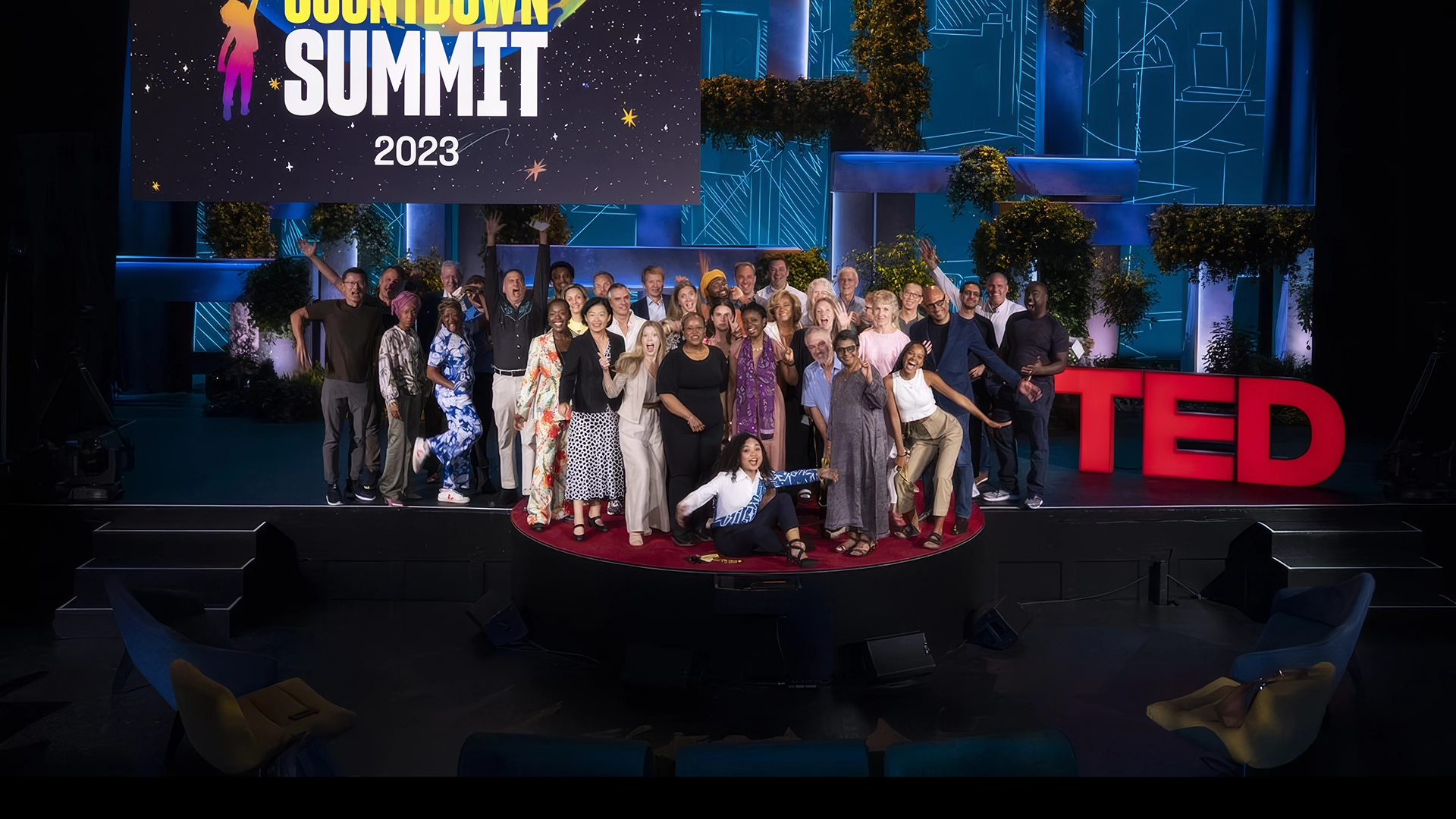
TEDx Countdown Summit 2023 - Detroit
Executive Summary
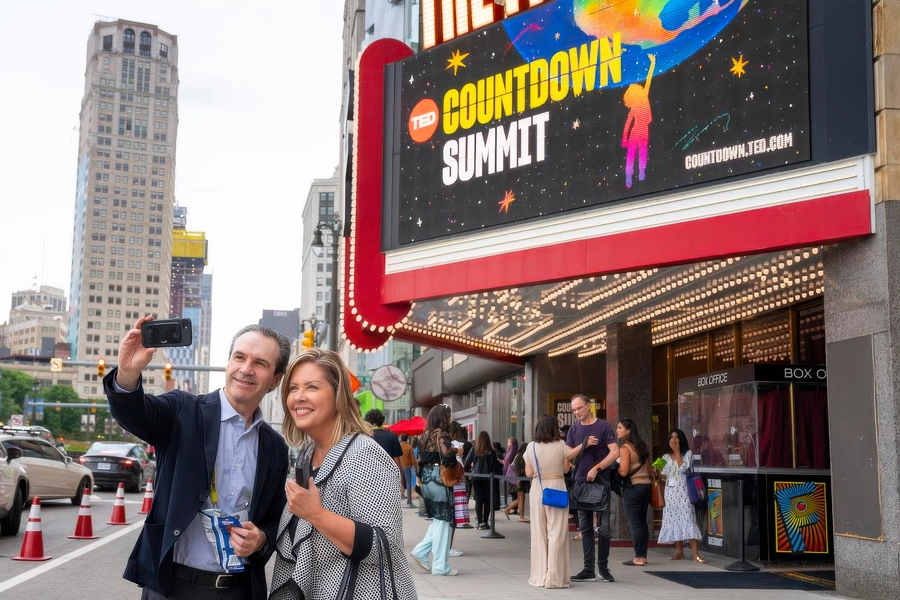
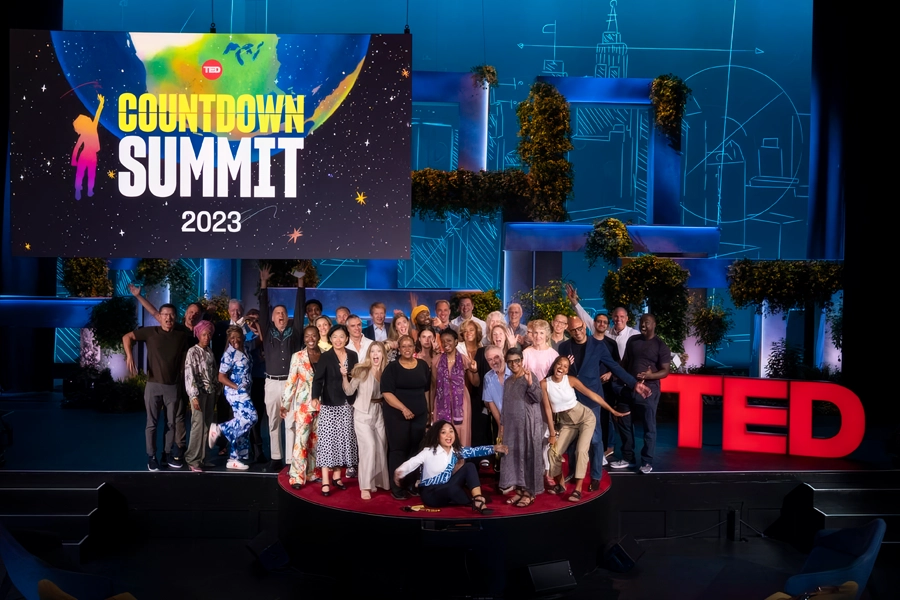
In July 2023, Display Group’s in-house design and fabrication division was commissioned to design and build the main stage environment for the TED Countdown Summit at the historic Fillmore Detroit. The four-day invite-only summit, held July 11 to 14, 2023, gathered 700 global leaders in climate innovation, science, policy, and business to confront one of the defining challenges of our time.
The brief was deceptively simple: create a stage that felt like Detroit. What the team delivered was something more. It was a fully realized environment that used the city’s own history, landscape, and resilience as the visual and emotional language of a global conversation. Through biophilic design, custom fabrication, hand-illustrated scenic elements, and a collaborative process that brought together internal teams, TED organizers, and local creatives, Display Group produced a stage that generated significant attention at the event.
This white paper details the creative strategy, production methodology, and cross-functional teamwork that made it possible. It also outlines the principles any event production team can carry forward.
Introduction
TED Countdown is TED’s global climate initiative, launched to accelerate solutions to the climate crisis. The 2023 Summit marked the program’s second major convening. The inaugural event was held in Edinburgh, Scotland, and the 2023 edition became its first in an American city. Detroit was a deliberate and meaningful choice.
The city sits at the center of the American automotive industry, which is itself navigating a significant transition: the shift to electric vehicles, a reckoning with decades of environmental impact, and the challenge of defining what a sustainable industrial future looks like. That combination of legacy and reinvention, of industrial power and ecological responsibility, made Detroit not just a convenient host city but a living argument for the summit’s themes.
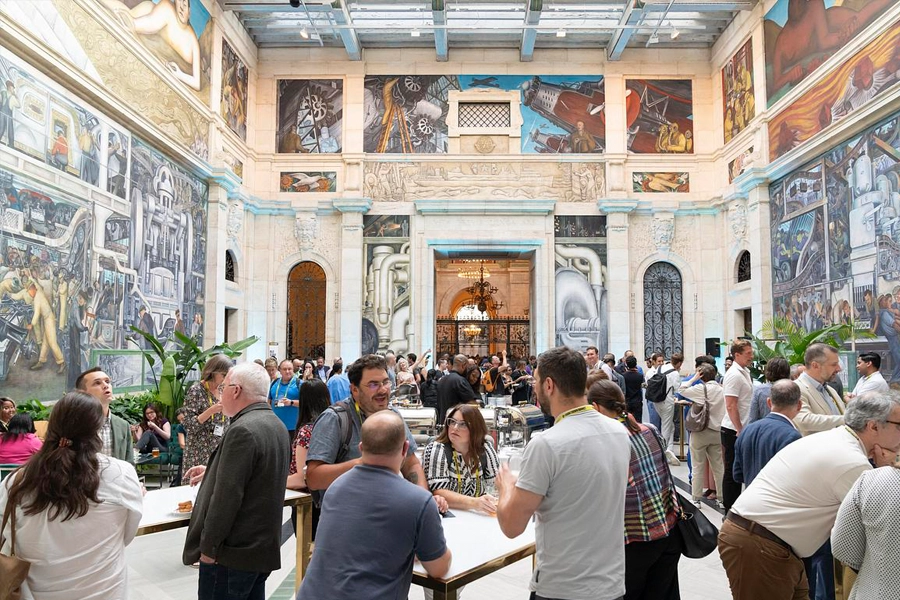
The summit ran July 11 to 14 at two venues: Michigan Central Station, the recently reopened historic rail terminal that has become a symbol of Detroit’s revitalization, and the Fillmore Detroit, a celebrated music venue at 2115 Woodward Avenue. The Fillmore hosted the mainstage TED Talks across seven sessions, featuring over 40 speakers from the worlds of climate science, policy, business, activism, and the arts.
Among the attendees and TED Future Forum founding companies were Ford, Google, Maersk, Nestlé, Siemens, BCG, and Mars. These organizations collectively represent enormous influence over global emissions trajectories. The Detroit Youth Choir opened the first session. Al Roker, Cynthia Williams of Ford, UNFCCC Executive Secretary Simon Stiell, and dozens of other prominent figures spoke from the stage that Display Group built.
The Brief: Designing a Stage for Detroit
When TED Conferences approached Display Group for the Fillmore stage, the directive was clear in spirit but open in execution. The environment needed to capture Detroit: not as a cliché or a tourism pitch, but as something honest and layered. A city of industry and nature. Of ruin and rebuilding. Of stories that deserved a global audience.
That brief demanded more than decoration. It required a design philosophy.
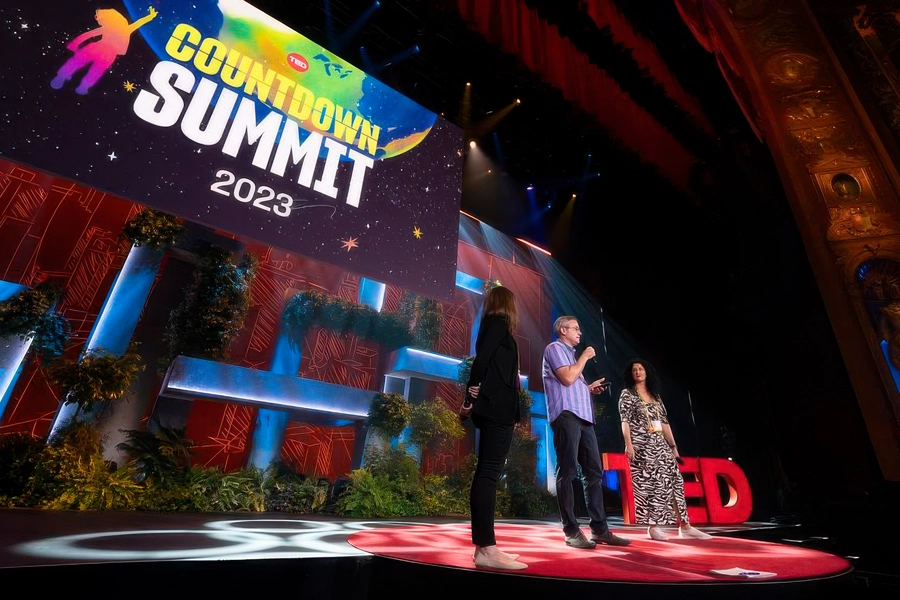
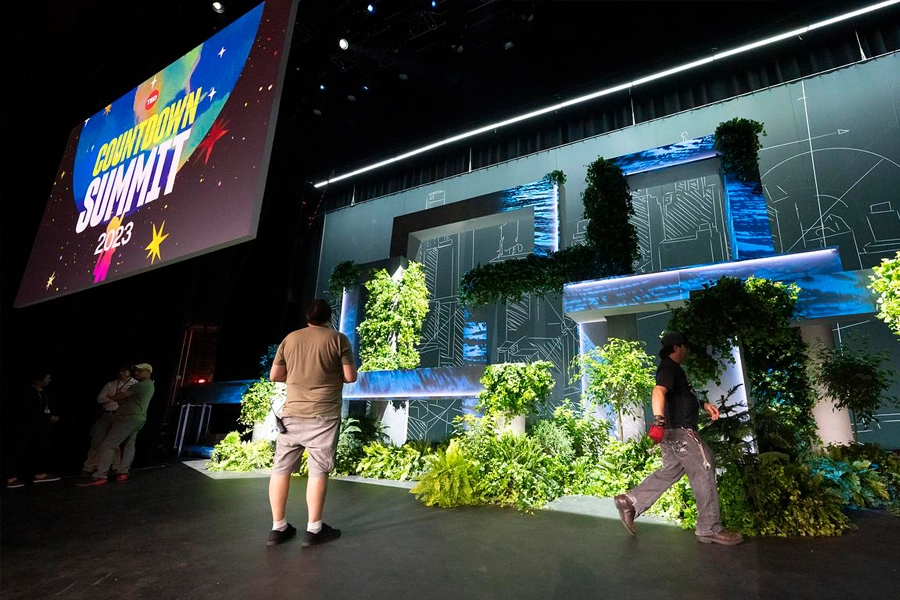
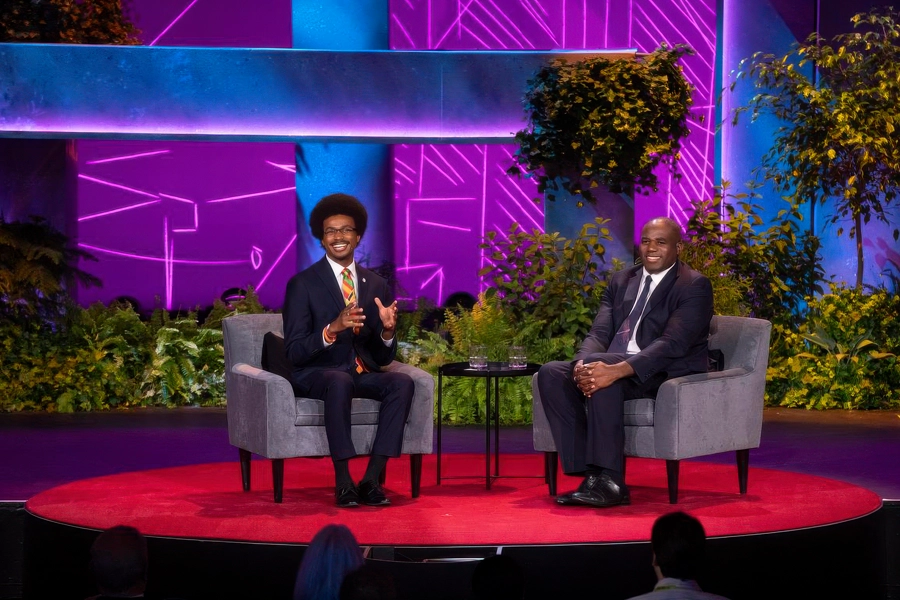
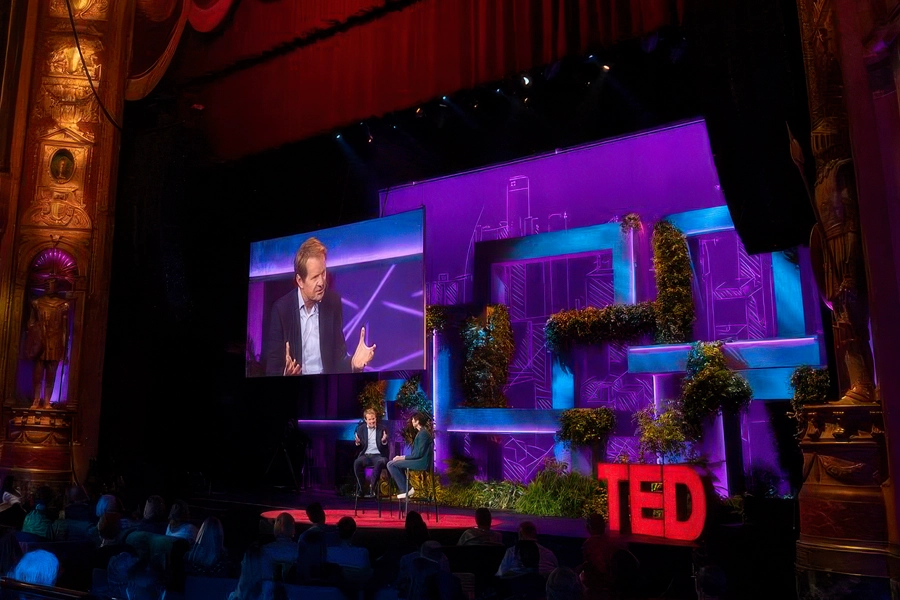
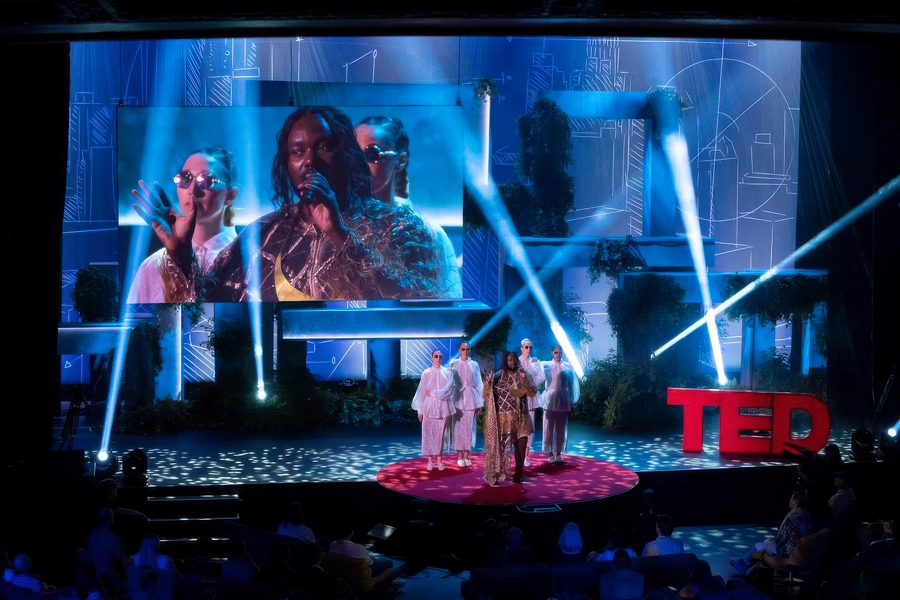
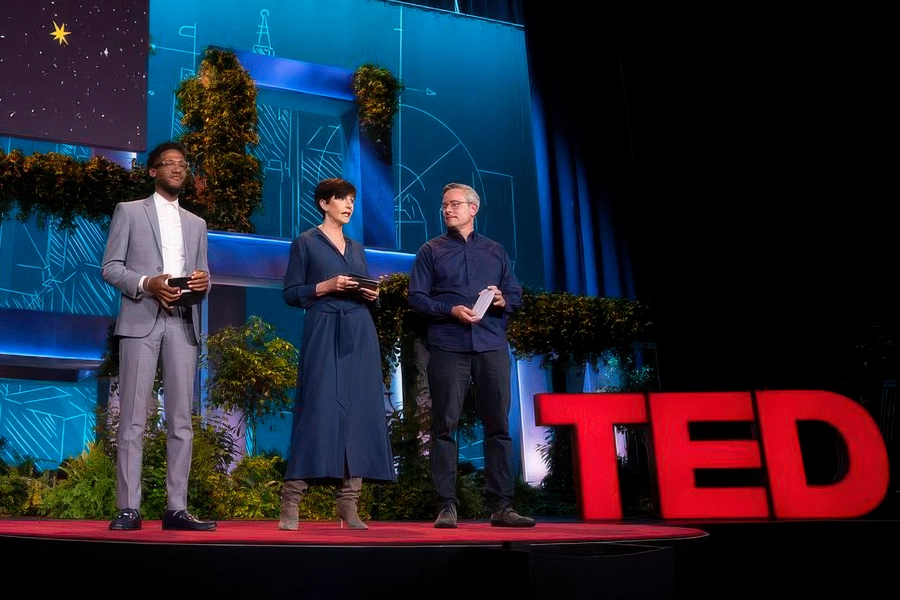
Display Group’s team interpreted the ask through two interconnected lenses. The first was Detroit’s architectural and industrial legacy, represented through the visual metaphor of a hand-drafted blueprint. The second was Detroit’s natural landscape, rendered through live greenery sourced from plants that quietly reclaim the city’s open spaces. Together, these two elements, one built and one grown, would frame the conversations happening on stage.
| “When the brief came in, we weren’t just thinking about what would look good on camera. We were asking what story this stage needed to tell, and how Detroit itself could tell it.”
Sara, Lead Designer, DG3D |
The broader design goals were:
- Create a stage environment that reflected Detroit’s identity without being literal or clichéd
- Incorporate living plant material to introduce warmth, texture, and biophilic connection
- Use a hand-illustrated backdrop concept to evoke the city’s architectural history and spirit of documentation
- Ensure the visual environment reinforced TED Countdown’s themes of regeneration, innovation, and forward motion
- Produce a stage that served the functional requirements of a multi-day, multi-speaker TED Talk format
The Design Concept: A City Between Its Past and Future
Abstract Forms and the Detroit Skyline
The primary structural language of the stage drew from Detroit’s architectural silhouette, interpreted not literally but abstractly. The team worked with fragmentary forms that suggested the city’s skyline without reproducing it: angles and geometries that evoke industrial structures, towers, and the kind of architectural optimism that defined Detroit’s mid-century rise.
The intent was dual. First, to locate the audience, both in the room and watching the livestream, unmistakably in Detroit. Second, to use those abstract forms as a visual metaphor for the summit’s themes: structures being rebuilt, systems being redesigned, a future still under construction.
| “We talked a lot about tension in the early design phases, between what the city was and what it’s becoming. The architectural forms gave us a way to hold both of those things at once.”
Sara, Lead Designer |
The Blueprint Backdrop: A Hand-Illustrated History
The backdrop design was one of the most technically involved and conceptually rich elements of the stage. Rendered in the style of a hand-illustrated architectural blueprint, it served as a visual index of Detroit’s many eras of innovation, from the auto industry’s founding decades to the city’s more recent creative and industrial reinvention.
Blueprints carry specific cultural weight in a city like Detroit. They are the language of the factory floor and the engineering department, of the drafting table and the prototype room. By adopting that visual grammar and applying it to Detroit’s own story, the team created a backdrop that felt both specific and universal: a document of where the city had been that simultaneously implied where it was going.
The hand-illustrated quality was deliberate. In an age where production design increasingly leans on digital rendering and LED surfaces, a drawn environment communicates something different: craft, intention, and the idea that a person sat down and thought carefully about what deserved to be recorded.
| “The blueprint concept was about documentation. Detroit has always had people who believed this city was worth preserving on paper. We wanted the stage to feel like someone had done that.”
Sara, Lead Designer |
Live Greenery: Nature Reclaiming Its Place
The integration of live plant material into the stage environment was not decorative afterthought. It was core to the concept. Detroit’s landscape tells a quiet ecological story that tends to go unnoticed: in the gaps left by demolition, in the lots between blocks, along rail corridors and waterways, nature has been making its slow return for decades.
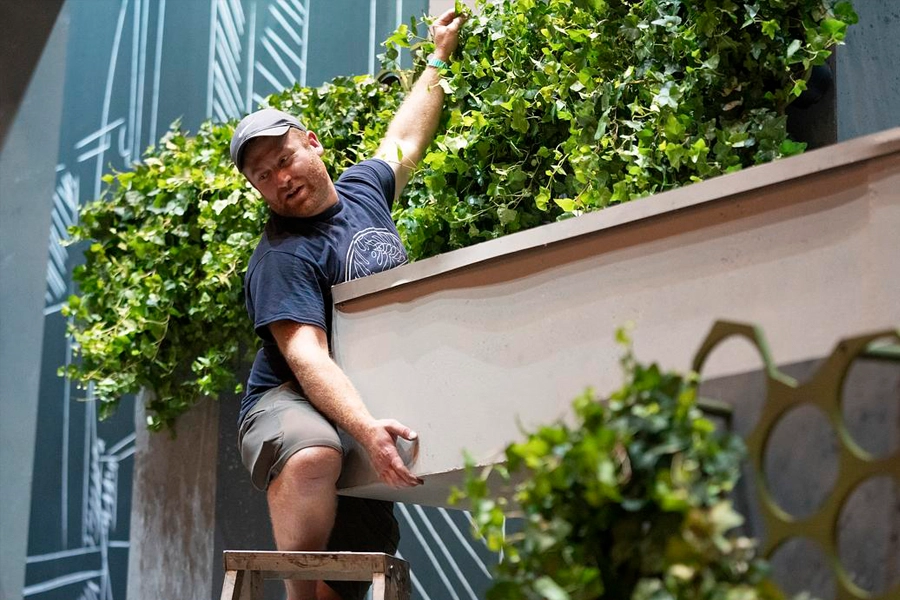
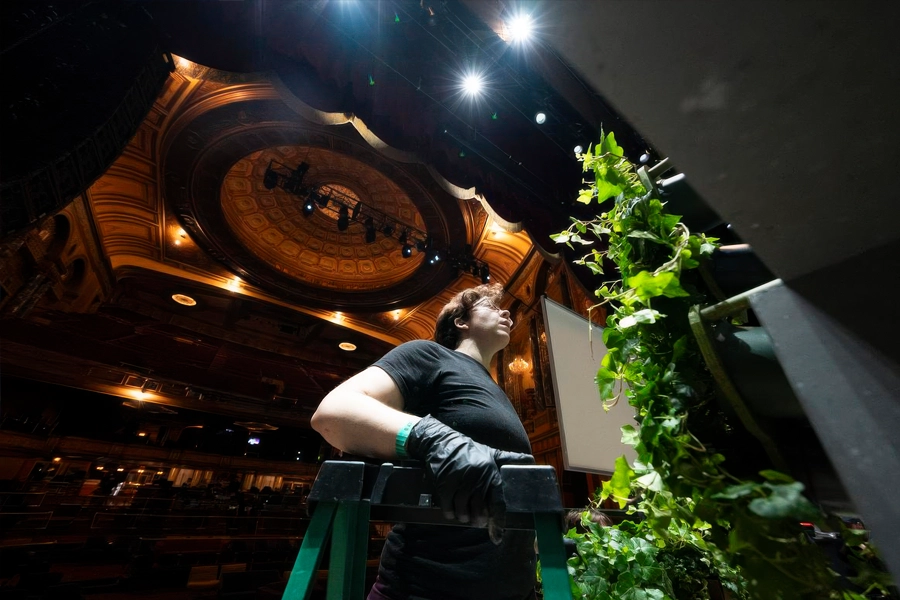
The plant species selected for the stage reflected that reality. Boston ferns, common ivy, tall grasses, and hydrangea shrubs were incorporated into the stage architecture in ways that blurred the line between built environment and living landscape. These are plants that could plausibly be found growing wild or tended in Detroit neighborhoods.
This approach aligned directly with the TED Countdown Summit’s broader thematic concerns. A global gathering of climate leaders, surrounded by living plants that speak to urban ecological resilience, creates a specific kind of coherence. The environment itself becomes part of the argument.
- Boston ferns: moisture-tolerant, lush visual texture
- Common ivy: trailing growth that softened structural edges
- Tall grasses: native-adjacent species that introduced movement
- Hydrangea shrubs: seasonal flowering plants that added color and density
The Production Process: From Concept to Stage
Collaborative Ideation
Large-scale event production is rarely a linear process, and the TED Countdown stage was no exception. The team operated as part of a wider creative ecosystem that included TED’s internal event team, summit speakers, local artists and community organizations, and Display Group’s own account management and production staff.
Early ideation sessions were exploratory and deliberately wide-ranging. Rather than arriving with a fixed concept and seeking approval, the team built a process that gathered input from multiple directions before narrowing toward an executional direction. TED’s curatorial priorities, the summit’s thematic framework, and Detroit’s own creative community all contributed material that shaped the final design.
| “My job is to hold the relationship and make sure the client’s vision is actually being heard throughout the process, not just at the brief and the reveal. With a client like TED, the details matter at every stage.”
John, Account Manager, Display Group |
TED’s collaborative approach to the Detroit summit included formal partnerships with Detroit Narrative Agency, Keep Growing Detroit, and Real Times Media. These partnerships created a production environment in which local knowledge and perspective were genuinely valued inputs. DG drew on that orientation, treating Detroit not as a backdrop to be simulated but as a co-author of the environment being built.
Iterative Design and Refinement
Once initial concepts took shape, the team entered an iterative refinement phase characterized by honest feedback loops and a willingness to revise. Early mock-ups were reviewed against both aesthetic criteria and practical production constraints: what could be built in the available timeframe, how it would read from the house, how it would translate on camera, and how the speaker on stage would experience the environment behind and around them.
Materials were tested. Lighting configurations were modeled. The spatial relationship between the blueprint backdrop, the architectural scenic forms, and the live greenery was adjusted repeatedly to find a composition that felt balanced without being static.
| “We probably went through six or seven distinct versions of the layout before we landed on the final configuration. Each pass taught us something. You can’t know how a stage is going to feel until you start putting it together in space.”
Alex, Production Manager, Display Group |
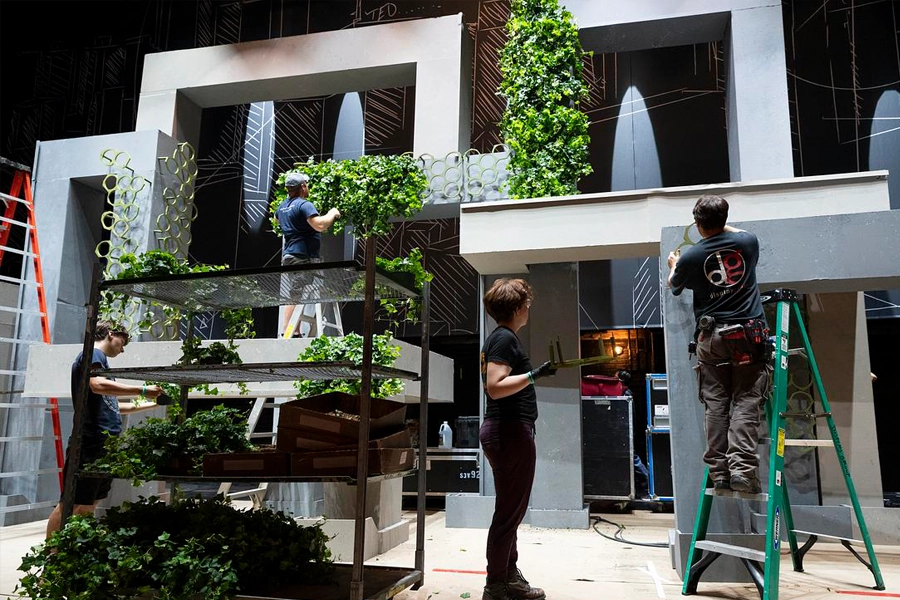
Fabrication and Installation
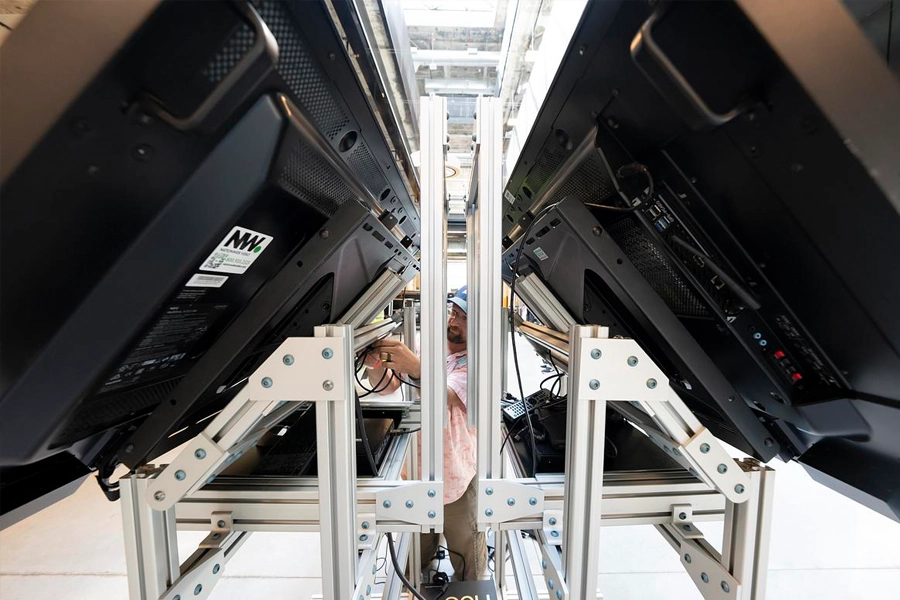
All custom scenic elements were produced in Display Group’s 300,000-square-foot Detroit facility, which houses woodworking, metalworking, CNC machining, 3D printing, and sculpting capabilities. The ability to prototype, revise, and fabricate within the same building compressed the feedback loop between design intent and physical output in ways that external fabrication partnerships rarely allow. The design team could walk the shop floor at any point in the process.
Installation at the Fillmore Detroit required precise coordination with the venue’s existing architectural constraints and with TED’s own technical and production requirements for the talk format. Display Group’s production management team coordinated the logistics of getting live plant material, custom-built scenic pieces, and lighting infrastructure into the historic venue on schedule and without compromising the integrity of any element.
| “The Fillmore is a beautiful building with its own strong presence. You don’t want to fight it, you want to work with it. Our install approach was about enhancing what was already there, not overwriting it.”
Alex, Production Manager, Display Group |
Lighting Integration
Lighting played a crucial role in allowing the stage to shift across four days and seven sessions. The blueprint backdrop, which relied on cool, graphic tones for its legibility, required careful calibration to ensure it read clearly under stage lighting conditions without washing out the plant material or flattening the scenic forms.
The team worked with dynamic lighting configurations that could be adjusted between sessions to shift the mood. Warmer, more intimate tones served opening night, while crisper, higher-contrast setups suited the midday talk sessions. This flexibility was essential for an event that spanned four days and covered topics ranging from grief over climate loss to optimism about clean energy breakthroughs.
The Client’s Perspective
TED Conferences arrived in Detroit with high expectations, not just for the talks but for the environment in which those talks would unfold. A summit built around the urgent question of how humanity designs its future demanded a stage that took that question seriously.
| “We’ve worked with production teams all over the world, and what stood out about Display Group was how deeply they engaged with the why of what we were doing. They weren’t just building a stage. They understood what the stage needed to communicate.”
Dave, Client Representative, TED Conferences |
The result, according to the client team, was an environment that succeeded on both the technical and experiential dimensions. It served the functional needs of a multi-day, multi-speaker conference while also contributing meaningfully to the summit’s narrative and atmosphere.
| “Walking into the Fillmore and seeing that stage for the first time, the blueprint, the greenery, the way everything worked together, it felt like Detroit was in the room. That was exactly what we wanted.”
Dave, Client Representative, TED Conferences |
Why It Worked: Key Production Principles
The TED Countdown stage illustrates a set of principles that recur across Display Group’s most successful event environments. They are worth articulating explicitly, because they apply to any production where environment and experience are expected to carry meaning.
1. The Environment Has an Argument to Make
The most effective event spaces are not neutral containers. They have a point of view. The TED Countdown stage was built around a specific thesis about Detroit: that the city’s identity lives in the tension between its architectural and industrial past and its ecological and creative future. Every design decision was tested against that thesis. When an element didn’t serve it, it was cut or changed.
2. Real Materials Do Work That Rendered Ones Cannot
The decision to use live plant material and hand-illustrated scenic elements rather than LED walls or digital projection was not a budget constraint. It was a creative one. In the context of a climate summit, living plants and hand-crafted surfaces communicate a relationship to the physical world that digital environments simply cannot replicate. The medium was part of the message.
3. Collaboration Is Not the Same as Consensus
The team involved a wide range of stakeholders, including TED organizers, local community organizations, speakers, and internal production staff, without losing authorial coherence. Collaboration informed the design; it did not dilute it. Knowing which input to integrate and which to set aside is a skill that comes from experience.
4. Iteration Is the Work, Not a Detour from It
Multiple rounds of revision are not a sign that the first concept failed. They are the mechanism by which a good concept becomes an exceptional execution. The willingness to tear apart a layout in the fourth revision and rebuild it is what separates finished work from great work.
5. Production Infrastructure Is a Creative Resource
Display Group’s in-house fabrication capabilities are not just a logistical convenience. When the design team can walk from their workstations to the shop floor and interact directly with fabricators, the creative process changes. Physical prototyping happens faster. Problems are caught earlier. The final product reflects more decisions made in three dimensions, not two.
Detroit as Stage: A City’s Moment on the Global Platform
Detroit’s selection as the host city for TED Countdown 2023 was significant beyond the logistical. The city was asked to be a case study, an argument, and a host simultaneously, demonstrating through its own ongoing transformation that the conversation about sustainable futures is not abstract. It happens in specific places, shaped by specific histories.
The Fillmore Detroit, opened in 1999 and one of the city’s premier live music venues, brought its own layers of meaning to the event. A space built for performance and shared experience, located on Woodward Avenue in a neighborhood that has undergone significant reinvestment in recent years, the Fillmore was not an incidental choice.
Michigan Central Station, the summit’s second venue, had just completed a major restoration and reopening as an innovation hub. The building had sat derelict for decades before Ford’s investment turned it into a mobility research campus. Together, the two venues told a story about Detroit that the summit’s programming then unpacked: a city that knows what it means to rebuild.
Display Group, as a Detroit-based company with over three decades of production history in the city, was well-positioned to translate that story into a physical environment. The TED Countdown stage was not just an event production project. It was a representation of the city by people who live and work in it.
About Display Group’s Design and Fabrication Division
Our division is the design and three-dimensional fabrication arm of Display Group, responsible for producing custom scenic environments, branded installations, trade show exhibits, stage elements, and immersive experiential spaces. The division operates within Display Group’s 300,000-square-foot Detroit facility and draws on the full range of in-house capabilities: woodworking, metalworking, CNC machining, 3D printing, sculpting, and custom graphic production.
DG works across a broad range of project types and scales, from intimate branded installations to full-scale conference stage environments. The division’s work is defined by a commitment to concept integrity, the belief that the physical execution of a design should be as considered as the idea behind it, and by the production discipline required to deliver complex environments on schedule.
Recent work includes stage and environmental design for the Michigan Central Station grand reopening concert (June 2024), branded experiences for automotive OEM clients including Ford, and large-scale decor and fabrication for corporate events serving Pepsi, Rocket Companies, and UWM.
About Display Group
Founded in Detroit in 1991 by Rick Portwood, whose family’s roots in the display industry stretch back to the 1920s through Display Creations, Display Group has grown over three decades into one of the Midwest’s most capable full-service event production companies. The company operates out of a 300,000-square-foot facility at 6235 Concord Avenue in Detroit and offers an unusually integrated suite of services under a single roof.
Under the leadership of President Mike McConnell, Display Group handles everything from large-scale audio-visual production and custom fabrication to furniture and decor rentals and complete event management. The Custom Fabrication division is the company’s dedicated 3D design and scenic fabrication unit, responsible for translating conceptual ideas into physical built environments: stages, branded installations, immersive backdrops, and experiential spaces.
Clients include Ford, Google, Pepsi, Rocket Companies, TED Conferences, Bedrock Detroit, UWM, Prudential, and Huntington Bank. The TED Countdown Summit engagement reflects Display Group’s growing position as a go-to partner for events where environment and experience are inseparable.
| KEY SERVICES DEPLOYED FOR THIS ENGAGEMENT
Custom scenic fabrication • Biophilic design and live plant installation • Hand-illustrated scenic backdrop production • Stage layout and spatial design • Lighting integration • Cross-functional project coordination |
Conclusion
The TED Countdown Summit 2023 stage at the Fillmore Detroit is one of the clearest expressions of what Display Group does at their best: build environments that carry meaning, not just visual interest. The blueprint backdrop documented a city’s layered history. The live greenery made a quiet argument about ecological resilience. The abstract scenic forms held the tension between what Detroit has been and what it is becoming.
Over four days, the stage served as the physical backdrop for conversations that reached audiences globally. Talks aired on TED.com and contributed to TED Countdown’s ongoing mission of accelerating climate solutions. The environment that held those conversations was not incidental to them.
That is the standard Display Group holds itself to: not that the stage looks good, but that it does work. That it earns its place in the room.
For information about Display Group’s event production, stage design, and custom fabrication capabilities, contact hello@displaygroup.com or call 313-965-3344. Visit displaygroup.com to explore our portfolio.